AI Visibility: The SEO Metric You're Not Tracking (And How to Start in 5 Minutes)
By Brad Erb
Search demand for the phrase "ai visibility" grew 3,150% year over year. That is not a typo. Something changed and most SEO dashboards have not noticed yet. AI Visibility is the new metric. This post tells you what it is, why it matters, and how to start tracking it on your domain in five minutes.
What AI Visibility Is
AI Visibility measures how often AI assistants cite your domain in their answers. ChatGPT, Claude, Gemini, and Perplexity all cite sources now. Some of those citations come back to your site. Most do not. The percentage that do is your AI Visibility.
We track it as a per-query metric and roll it up into a Share of AI Voice score. For a single keyword like "best fiberglass pool installer maryland," your Share of AI Voice is the percentage of the four major models that cite your domain when asked. For your full keyword set, it is the weighted average across every tracked query.
AI Visibility is the closest thing the AI search era has to "Google rank position." It is not a perfect parallel because AI answers are generative, not ten blue links. But it is the leading indicator of whether a buying-stage prompt sends a user to your site or to a competitor's.
Why This Suddenly Matters
The traffic mix is shifting. ChatGPT now serves north of 800 million weekly users. Perplexity is doubling year over year. Claude inside Cursor and Claude Desktop drives a research workflow that never touches Google. Gemini ships in Android, Chrome, and the Workspace suite by default.
A growing share of high-intent queries get answered before the user ever opens a browser tab. If you are not in the answer, you are not in the consideration set. Your old SEO tool will not tell you because it was built to track the ten blue links that AI assistants are quietly replacing.
This is the gap. AI Visibility fills it.
The Trend in One Number
The keyword "ai visibility" itself grew from negligible search volume to 480 monthly searches in twelve months. That is +3,150%. The category is forming in real time. The companies that plant a flag now will own the metric the way Ahrefs owned "domain authority" in the 2010s. The companies that wait will pay to license it later.
What This Looks Like in the Wild
Before we get philosophical about the metric, here is what an actual snapshot looks like. We ran 48 live AI queries on 2026-05-08 — three representative searches per brand, against ChatGPT, Gemini, Claude, and Perplexity — for four brands you have heard of. We measured how often each model cited the brand's own domain in its citation list versus just naming the brand in the answer text.
| Brand | ChatGPT | Gemini | Claude | Perplexity | Cited (12 scans) | Mentioned |
|---|---|---|---|---|---|---|
| Vercel | 0/3 | 1/3 | 1/3 | 2/3 | 33% | 100% |
| Stripe | 0/3 | 0/3 | 1/3 | 2/3 | 25% | 100% |
| Salesforce | 0/3 | 0/3 | 0/3 | 2/3 | 17% | 100% |
| Linear | 0/3 | 0/3 | 1/3 | 0/3 | 8% | 92% |
Three findings stand out.
Mention is not citation. All four brands are named in the answer text on essentially every query. Their own domains are cited a fraction of the time. This is the gap most SEO teams miss. A mention is a thank-you note from the model. A citation is a link the user can click — it is the part that sends traffic.
ChatGPT cited zero brand domains. Across 12 queries, on the brands' home turf — "best payment processor for SaaS startups" against Stripe, "best CRM for enterprise sales teams" against Salesforce — ChatGPT did not link to any of them. The pages it cited instead were Reddit threads, independent comparison sites (devpick.io, thesoftwarescout.com, makerkit.dev), and category aggregators. That is where AI search traffic is going, and reverse-engineering those pages is the highest-ROI move most teams have not made yet.
Per-platform variance is huge. Citation counts across all four brands × 12 queries: ChatGPT 0/12, Gemini 1/12, Claude 3/12, Perplexity 7/12. AI Visibility is not one number. It is four. Optimize for the gaps.
If You Run an Agency, This Is the Audit You Should Be Selling
If even Stripe lands at 25% and Salesforce is invisible to ChatGPT entirely, your clients — local services, regional brands, mid-market SaaS — are almost certainly at 0%. That gap is the audit. That gap is what you sell.
The 48 queries above took six minutes to run with the free scanner. Run them on five of your clients and you have a quarterly retainer add-on that costs you about thirty minutes per client and bills at $1,000 to $3,000 depending on your shop's rate.
The work itself is not complicated:
- Scan the client's domain across all four models for their ten highest-intent queries.
- Identify the cited pages — usually Reddit threads, comparison sites, or competitors. Those are the pages your client needs to get on, not their own pages.
- Build entity-association content that earns citations: lead with the answer, structured comparisons, brand-adjacent topical authority.
- Track weekly so you can show movement — or its absence — on the next QBR.
Studio ($299/mo) tracks 15 client domains, 2,500 keywords, across all four models. We built it because we run our own agency-style book and the existing tools do not fit how agencies bill or report. More on the agency setup.
What "ChatGPT SEO" Actually Means
You will see a lot of takes on ChatGPT SEO over the next year. Most are wrong. Here is the honest version.
ChatGPT SEO is not "stuff your page with FAQ schema and pray." ChatGPT does not browse FAQ schema. It does not even browse most of the time. When it does, it uses a hybrid retrieval system: a baseline of training data plus live web searches via Bing. What gets cited depends on three things:
- Whether your content is in the index Bing serves to ChatGPT. Indexability matters. Slow pages, JavaScript-rendered content, and noindex tags get filtered out.
- Whether your page directly answers the user's question in the first 200 to 500 tokens. ChatGPT skim-reads. Buried answers do not get cited.
- Whether your domain has authority signals the model trusts. The signals are not Google's PageRank. They are co-citation patterns from the training data, brand recognition in the corpus, and link graphs Bing surfaces.
Same logic for Claude (which uses its own retrieval), Gemini (which uses Google), and Perplexity (which uses its own crawler plus paid search APIs).
The point: optimizing for AI assistants is not a separate discipline. It is SEO with one extra constraint. The page has to be parseable, the answer has to be findable, and the brand has to be trusted. AI Visibility tells you whether you cleared the bar.
What "SEO For ChatGPT" Looks Like in Practice
Three concrete moves that compound:
Lead with the answer. Your H1 should match the query. The first paragraph should answer it in plain English. Save the storytelling for the body. AI assistants quote the top of the page far more often than the bottom.
Use comparison structures. Tables, bullet lists, and "X vs Y" framings get cited disproportionately. The retrieval logic loves clean structure. So do skim-reading humans, by the way.
Build entity associations. If you want to be cited for "best fiberglass pool installer in Maryland," your domain needs to appear next to those entities (fiberglass pool, Maryland, installer) across multiple authoritative pages. This is not new SEO. It is just SEO with a tighter feedback loop.
You can verify the work landed by checking AI Visibility before and after. That is the loop most people are missing.
The 5-Minute AI Visibility Audit
Here is how to baseline your AI Visibility in five minutes without a credit card.
Step 1 — Open the free tool
Go to transformseo.com/tools/ai-visibility. You will see a single input field. Drop your domain in. No signup. No card.
Step 2 — Pick your money keywords
The tool defaults to scanning your top organic keywords (pulled from public SERP data). For a five-minute baseline, override that with three to five queries you actually care about. Examples:
- "best [your category] in [your city]"
- "[your category] vs [competitor]"
- "how to [job your customer is doing]"
- A long-tail buyer query you want to win
Step 3 — Run the scan
The tool fires live queries against ChatGPT, Claude, Gemini, and Perplexity. It captures the full response text and the citation list. This usually takes 20 to 40 seconds because we wait for real responses, not cached ones.
Step 4 — Read the Share of AI Voice scorecard
You will get back a per-model breakdown:
- Cited — your domain appears in the citation list.
- Mentioned — your brand is named in the response text but not linked.
- Absent — neither.
- Competitor cited — who took your slot, with the URL.
The Share of AI Voice number is the rolled-up percentage. A score of 100% means all four models cite you for every query. A score of 0% means none of them do.
Step 5 — Read the gap analysis
For every "absent" result, the tool tells you what page got cited instead. Click through. Read it. Compare against your equivalent page. Nine times out of ten the cited page does one of three things better:
- Answers the query in the first paragraph
- Has a clean comparison table or bullet structure
- Sits on a domain with stronger entity association
That diff is your roadmap. Most AI Visibility wins come from boring on-page tightening, not new content.
How to Track AI Visibility Over Time
The free tool gives you a snapshot. AI Visibility is a moving target. The models retrain. The retrieval indexes update. Your competitors publish. A snapshot from last Tuesday is already stale by next Friday.
Inside the product, AI Visibility runs on a schedule. Pick the keywords you want monitored, set a cadence (daily, weekly, or monthly), and the system fires the queries on autopilot. You see a chart of Share of AI Voice over time, alerts when a competitor takes a citation, and a diff log of which page got swapped in.
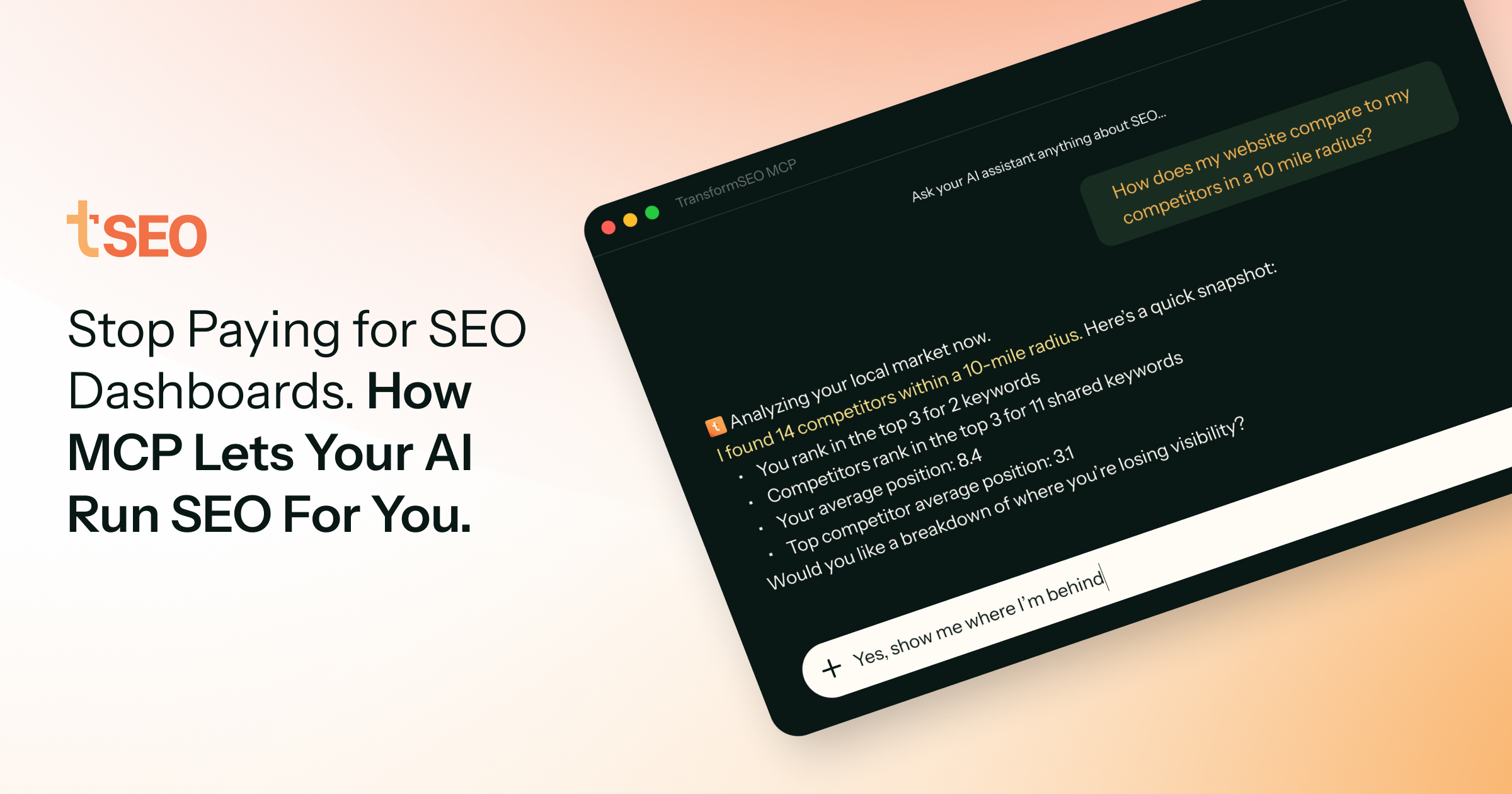
The whole tracker is also exposed via MCP. So if you live inside Claude or Cursor, you can ask "did my AI Visibility move this week?" on a Monday morning and get a real answer in the chat. No tab opened.
For the depth on how the MCP layer makes this work, read Stop Paying for SEO Dashboards: How MCP Lets Your AI Run SEO For You.
The Three Mistakes Most People Make
I have watched a hundred founders run their first AI Visibility audit. Three patterns repeat.
Mistake 1: Tracking every keyword. A 1,000-keyword AI Visibility scan is noise. You cannot act on it. Pick the 10 to 25 queries that drive your business and track those weekly. Add more only when you have shipped fixes for the first set.
Mistake 2: Optimizing for ChatGPT only. ChatGPT is the loudest model. It is not the only model. Claude has a different citation algorithm. Gemini is plugged into Google's index, which weights different signals. Perplexity weights freshness heavily. Track all four. Optimize for the gaps.
Mistake 3: Treating "mentioned" as a win. A brand mention without a citation is a thank-you note from the model. It does not send traffic. Citations send traffic. Mentions matter for brand-building. Citations matter for revenue. Don't conflate the two.
What AI Visibility Does Not Tell You
Honesty matters. Here is what AI Visibility cannot do for you.
It does not tell you how many users actually saw the answer. The models do not publish per-query traffic. We can only measure citation presence, not impression count. Treat it as a leading indicator, not a revenue dashboard.
It does not work for queries the models refuse to answer. If your category is "buy crypto from anonymous wallets," ChatGPT will hedge and you will get noisy reads. The metric is solid for normal commercial intent. It gets fuzzy at the edges.
It does not replace Google rank tracking. AI assistants still send a minority of high-intent traffic. Google is still the majority. AI Visibility is additive, not a substitute. We track both inside transformSEO for the same reason.
Where This Goes Next
The next version of AI Visibility will measure two things we cannot measure yet:
- Cited share of voice for AI Overviews. Google's AI Overviews are now generating cite blocks above the organic results. Tracking that surface is the obvious next move. We are building it.
- Action capture inside AI agents. When a buyer asks Claude to "find me a fiberglass pool builder in Bel Air, MD" and Claude returns a shortlist, we want to measure not just citation but ranking inside the shortlist. That is closer to a true conversion signal. It is harder. We will get there.
The category is two years old. The metric is six months old. The companies that ship the next instrumentation will set the rules.
Where to Start
Three paths, in order of intent:
- Free scan, no signup. Run the AI Visibility scanner on your domain right now. Five minutes. The fastest baseline.
- Pro — where most teams land. $129 a month, or $103 on annual. Five sites. 600 tracked keywords scanned daily across ChatGPT, Claude, Gemini, and Perplexity. Full MCP toolkit your AI assistant can call. 14-day free trial, no card to start.
- Studio for agencies. $299 a month, or $239 on annual. 15 sites, 2,500 keywords, 15 team seats. Cross-client Mentions, cross-client Competitors, AEO Health per site. The agency canvas.
The free scan is the fastest baseline — every founder should run it once. Pro is where teams that take AI search seriously settle by month two: full toolkit, daily share-of-AI-voice tracking, real keyword coverage. Agencies running 5+ client sites jump to Studio. There's a free account if you want to noodle on the dashboard before subscribing, but the 14-day Pro trial is the path that actually locks in the workflow.