Stop Paying for SEO Dashboards: How MCP Lets Your AI Run SEO For You
By Brad Erb
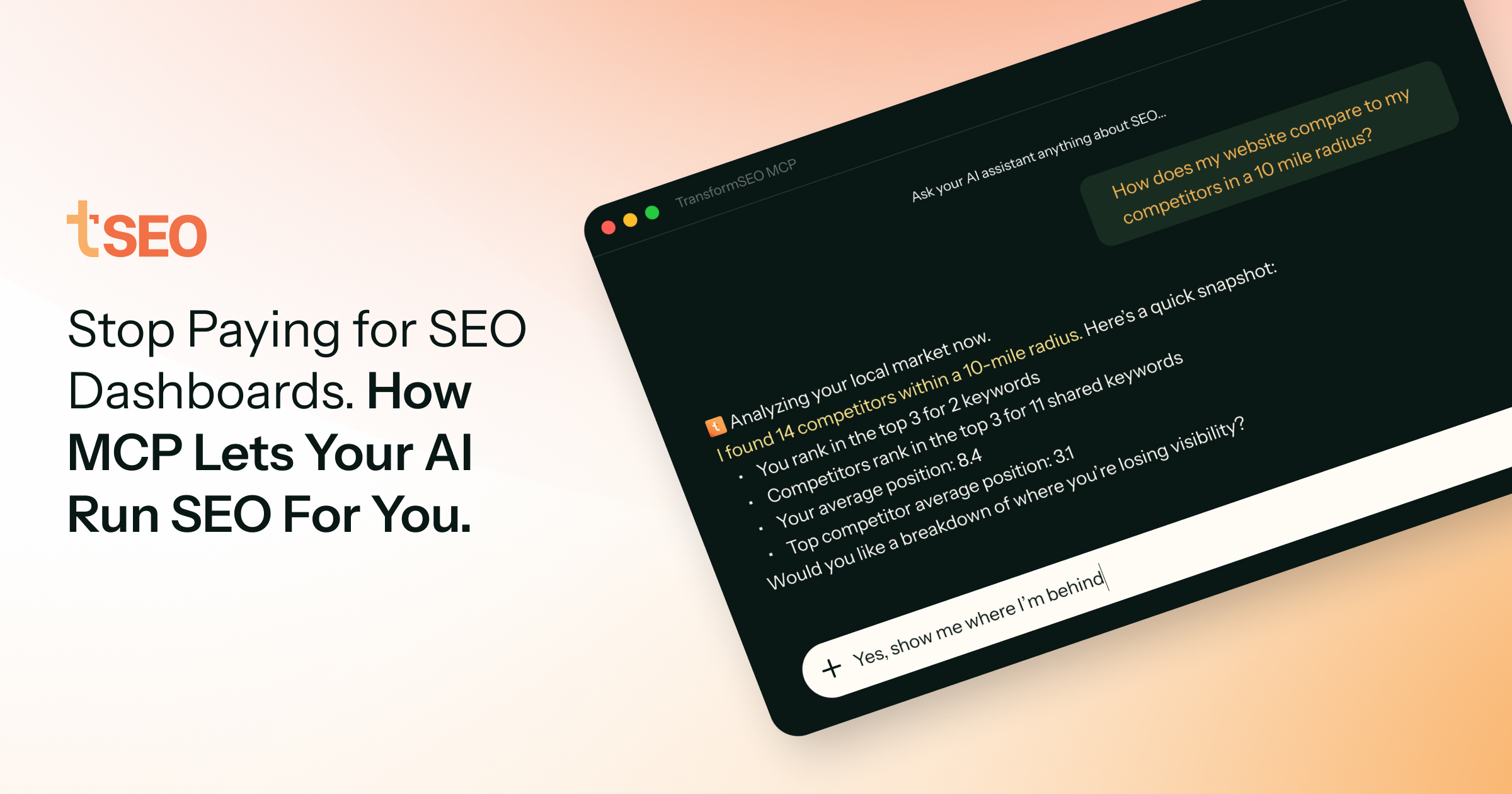
Most SEO tools give you data. transformSEO gives you answers.
That distinction sounds subtle. It isn't. Open your SEO tool right now. Traffic is down 12%. Referring domains ticked up. Three keywords dropped out of the top ten. Now what? Somewhere between the chart and the Slack message, the insight gets lost — or it becomes someone's job to translate data into a recommendation that could have just been a sentence.
Here's something else we kept hearing on customer calls: people aren't researching SEO questions in tools anymore. They're asking them. In Claude. In ChatGPT. In Cursor. "Why did our traffic drop?" is a conversation now, not a reporting session.
Most SEO tools were built before AI assistants existed. It shows. You pay $99 to $999 a month for a dashboard, then you spend Tuesday afternoon copying numbers out of it into a spreadsheet so Claude can read them. That workflow is broken. MCP SEO fixes it.
This post explains what MCP is, why it changes how SEO work gets done, and what it looks like to hand off real keyword research, rank tracking, audits, and AI Visibility checks to Claude or ChatGPT in one conversation. By the end you will know how to wire your AI assistant to 182 SEO tools and stop opening tabs.
What MCP Actually Is (Without the Hand-Waving)
MCP stands for Model Context Protocol. Anthropic released it in late 2024 as an open standard. It is a small, boring spec that does one big thing: it lets an AI assistant call external tools the same way a developer calls an API.
Before MCP, plugging Claude into your data meant building a custom integration for every app. Each one was a snowflake. After MCP, any app that ships an MCP endpoint is callable by any AI assistant that speaks MCP. Claude Desktop. Claude Code. Cursor. Continue. Zed. The list is growing every week.
That is the only reason this post exists. SEO data has been trapped behind dashboard logins for fifteen years. MCP is the door.
The Three Pieces
An MCP setup has three parts:
- The MCP server. A backend service that exposes tools. transformSEO is an MCP server. It exposes 182 SEO tools at one endpoint.
- The MCP client. Your AI assistant. Claude Desktop, Cursor, ChatGPT (Pro now ships native MCP support).
- The transport. How the client talks to the server. HTTP streaming for hosted servers like ours, stdio for local ones.
You add one line to your client config. The assistant discovers every tool the server offers. You ask in plain English. The assistant picks the right tool, runs it, reads the result, decides what to do next.
No dashboards. No API keys to juggle. No Zapier. No CSV exports.
Why "MCP SEO" Is a Category, Not a Feature
A lot of SEO companies have shipped "AI" features in the last 18 months. Most are wrappers: a chat box bolted onto a dashboard that summarizes the same data you were already looking at. That is not the shift. The shift is the AI doing the work.
MCP SEO means your AI assistant runs the SEO process itself:
- It picks the keywords to research.
- It runs the volume and difficulty checks.
- It pulls the SERP, reads the competitors, drafts the brief.
- It tracks the new ranks.
- It re-checks AI Visibility next week and tells you what moved.
You stop being the operator of the tool. You become the editor of the AI's output. That is a different job. It is faster. It is also where SEO is going whether your current vendor caught up or not.
The Volume Problem
There are 182 tools in the transformSEO MCP catalog. No human is going to memorize them. That is fine. The whole point of an LLM is it can. When you ask Claude "show me which keywords my site lost ground on this month," it picks the right tool from the catalog, fills the parameters, and runs it. You did not need to know the tool's name. You did not need to read the docs.
This is the workflow Ahrefs and Semrush cannot ship without rebuilding from scratch, because their products are dashboards first and APIs second. MCP SEO is APIs first and the dashboard is a side view for humans.
The 182 Tools, Roughly Sorted
The tool catalog spans 15 categories. You do not need to remember them. Your AI does.
- Keyword research. Ideas, suggestions, related terms, search intent, monthly trends, bulk difficulty.
- Rank tracking. Live SERPs, historical rank, position changes, shared rankings.
- Backlinks. Referring domains, anchors, lost links, competitor link profiles, spam scores.
- SERP analysis. Live organic results, featured snippets, People Also Ask, SERP feature presence.
- On-page audits. Core Web Vitals, Lighthouse scores, content parsing, instant page snapshots.
- Site audits. Full crawl, broken link discovery, redirect chains, internal linking maps.
- Local SEO and Google Business Profile. Listings search, review tracking, GBP insights, local pack rankings.
- AI Visibility / AEO. ChatGPT, Claude, Gemini, Perplexity mention tracking. Share of AI Voice scoring.
- Social signals. Share counts, mention tracking, brand sentiment.
- Ads research. Competitor ad copy, paid keyword overlap.
- YouTube SEO. Video ranks, comment sentiment, subtitle parsing.
- Shopping. Product listing ads, price comparison.
- Trends. Google Trends, demographic breakdowns, regional interest.
- Technographics. Tech stack detection, WHOIS, SaaS competitor mapping.
- Workspace and portfolio. Pin findings, share with clients, agency rollups.
That is the full surface. One MCP endpoint. One Claude conversation. No tab juggling.
Watch It Run: A Real Conversation
Here is a session from a Tuesday morning. I am working on a regional pool builder client. I want to know what is moving and what to write next.
That whole exchange took 90 seconds. Five tool calls. No tabs opened. The output is a tracked keyword, an AI Visibility baseline, a SERP snapshot pinned for the team, and a FAQ draft sitting in my workspace ready to ship.
That is what MCP SEO looks like in practice.
SEO Automation That Is Not Just Scheduled Reports
The phrase "seo automation" usually means "we run a crawl on a cron job and email you a PDF." That is not what is happening here. The automation in MCP SEO is on the decision layer, not the data layer.
When Claude is the operator, it can:
- Notice that three of your top 20 pages dropped position this week and immediately pull the SERPs to figure out who took your spot.
- Detect that your AI Visibility for a money keyword went from 75% to 25% and trace it to a fresh blog post from a competitor.
- Run a weekly diff of your backlink profile and tag the new losses against the pages that dropped.
- Build a content brief from the live SERP, the People Also Ask, and your own internal linking graph.
- Decide which write tool to call next, with no human in the middle, because each tool returns enough context to make the next decision.
That last bullet is the unlock. Most SEO APIs return raw data and trust the human to know what to do with it. MCP tools return data plus structured next-action pointers. Our pin-to-workspace write tool returns the full block plus the URL of the workspace plus a next_actions.view link. The agent can hand you a clickable result without an extra round-trip.
The Capability Discovery Problem (And Why We Solved It)
Every SEO MCP server eventually hits the same wall: the agent calls a tool that needs a Google Search Console connection, gets back a permission error, and apologizes to the user. That is a bad experience. It also burns tokens.
We ship a tool called list-site-capabilities. You call it once at the start of any session and you get back the full per-site tool inventory with a four-state availability enum:
- ready — connected, fresh, fire away.
- degraded — connected but stale (data is older than 7 days).
- unavailable — needs a sync to be triggered.
- blocked — needs an OAuth connect, a plan upgrade, or a tracked keyword first.
Each blocked or unavailable state ships with structured remediation: an OAuth connect URL, a sync tool to call, a plan upgrade page, or a write tool to invoke. The agent reads it and either fixes the gap itself or asks you for one specific permission.
This is the difference between an AI that gives up and an AI that finishes the job. Most MCP servers do not ship this. We do.
The Read/Write Symmetry Rule
We learned this from watching Stripe's MCP retrofit take 18 months. Every write tool in our catalog ships with one of two things:
- A paired read tool in the same release. Add a tracked keyword? There is a list-tracked-keywords tool and a get-keyword-ranking-history tool that ship with it.
- A canonical response body. Pin a workspace block? The write tool returns the full block, the workspace metadata, and the view URL. The agent has read-after-write inside the same MCP turn.
Without one of these, the agent is flying blind. It calls a write tool, gets back a status code, and has no idea if the change took. We do not ship write tools without the symmetry. That is the merge gate. Every PR gets blocked at it.
What This Means for Your Stack
If you run an agency with 5–50 client sites, the dashboard math gets worse for you faster. Every client is a new tab, a new login, a new export-to-spreadsheet, a new place a number can go missing. MCP SEO collapses that to one conversation per client, or one rollup conversation across the portfolio.
You probably have an SEO tool subscription right now. You probably are not going to cancel it on day one. Fine. Here is the realistic path:
Week one. Connect transformSEO to Claude Desktop or Cursor. Run a few queries against your site. See how it feels to ask in English.
Week two. Replace your weekly rank tracking ritual with a Claude conversation. Save the time.
Week three. Start running AI Visibility on your money keywords. Your old tool does not do this and the gap matters more every quarter.
Week four. Decide which Ahrefs or Semrush features you actually used in the last 30 days. For most of you the answer is "rank tracking, a few SERP pulls, and a backlink check." All three are in the MCP catalog. The math gets honest fast.
This is not a "rip and replace" pitch. It is a "the workflow shifted under your feet" observation. MCP SEO is the new layer. Your legacy tools become data backstops.
The Pricing Story (Quickly)
We ship four self-serve tiers plus an Enterprise anchor. They map to how much horsepower you need from the MCP layer.
- Free. $0 forever. 1 site. 25 tracked keywords. 1,000 credits at signup so you can feel the live tools, not just the read-only ones.
- Solo. $39 a month. 1 site. 150 keywords. 3,000 monthly credits. For one founder with one site they care about.
- Pro. $129 a month. 5 sites. 600 keywords. 15,000 credits. PR Opportunities (50 drafts/mo) included. This is where most paying customers land.
- Studio. $299 a month. 15 sites. 2,500 keywords. 50,000 credits. PR Opportunities (250 drafts/mo) included. Built for agencies running 10+ client sites.
- Enterprise. Talk to us. Unlimited everything, dedicated CSM, white-label, BAA / SOC2, custom OAuth scopes.
Annual prepay saves 20% on every paid tier. Solo $32/mo, Pro $103/mo, Studio $239/mo when paid yearly.
Compare that to the $399 to $999 you are paying a legacy tool whose API your AI cannot natively call. The math is not subtle.
Try It Without Signing Up
Two free tools live on the marketing site. No card. No signup. Just paste a URL.
- AI Visibility scanner. Drop a domain at /tools/ai-visibility. We run live queries against ChatGPT, Claude, Gemini, and Perplexity and tell you who cites you for your money keywords.
- Instant SEO audit. Drop a URL at /tools/page-audit and get a full snapshot in under 30 seconds.
Both run on the same MCP tools your AI assistant will use after you sign up. They are the cheapest way to feel the workflow before you commit.
How This Connects to AI Visibility and GEO
MCP is the plumbing. AI Visibility is the metric MCP makes trackable for the first time. Generative Engine Optimization is the discipline that grows up around it. These are three layers of the same shift.
If you want to go deeper on the metric side, read AI Visibility: The SEO Metric You're Not Tracking. If you want the strategic field guide, read Generative Engine Optimization (GEO): The 2026 Field Guide.