Generative Engine Optimization (GEO): The 2026 Field Guide
By Brad Erb
Search demand for "generative engine optimization" grew 184% year over year. "Geo seo" grew 510%. "Answer engine optimization" grew 230%. "AI search optimization" grew 400%. The category is in the steep part of the curve. This guide is the field manual: what GEO is, how it differs from AEO and LLMO, what carries over from traditional SEO, what is net-new, and how to build a 2026 program that compounds.
This is long. Bookmark it. The TLDR is simple though: SEO did not die. It widened. The same skills win. The metrics you measure changed.
Definitions, Done Cleanly
The acronym soup is real. Let's clear it.
GEO — Generative Engine Optimization. The discipline of getting your content surfaced inside generative AI answers (ChatGPT, Claude, Gemini, Perplexity, Google AI Overviews). The "engine" word is intentional. The systems are search engines plus generation layers, not chatbots in a vacuum.
AEO — Answer Engine Optimization. A narrower frame focused on direct-answer surfaces (featured snippets, People Also Ask, AI Overviews, voice assistants). Predates GEO. Most of AEO folds into GEO now.
LLMO — Large Language Model Optimization. Focuses on the citation behavior of pure LLMs (ChatGPT, Claude) regardless of whether retrieval is involved. Less common term. Increasingly used as a synonym for GEO.
AI Search Optimization. The most consumer-friendly phrase. Marketing-team language for the same set of practices. Search demand is climbing fastest here (+400% YoY) because the buyer-side terminology is settling.
For the rest of this guide I will use GEO as the umbrella term. AEO, LLMO, and AI Search Optimization are subsets or synonyms. If you see one in the wild, treat it as GEO with a slightly different camera angle.
GEO vs AEO vs LLMO vs Traditional SEO: The Comparison
| Dimension | Traditional SEO | AEO | LLMO | GEO |
|---|---|---|---|---|
| Primary surface | Google blue links | Featured snippets, PAA | LLM responses (no retrieval) | All AI answers + citations |
| Optimization unit | Page | Direct answer block | Training corpus presence | Page + entity + citation graph |
| Measurement | Rank position, CTR | Snippet ownership | Brand mention frequency | AI Visibility, Share of AI Voice |
| Time to result | 3 to 6 months | 1 to 3 months | 6 to 12 months (slow) | 2 to 8 weeks |
| Signals that matter | Backlinks, on-page, authority | Schema, structured answers | Co-citations, brand corpus | All of the above + retrieval index |
| Tools that track it | Ahrefs, Semrush, GSC | Same + position 0 trackers | Almost none until 2025 | transformSEO, AI Visibility tools |
| Established since | 2000s | 2010s | 2023 | 2024 |
The big takeaway from the table: GEO is not a replacement for the others. It is the union. A 2026 program ships traditional SEO, AEO, and LLMO motions under one strategy and measures the result with AI Visibility metrics.
What Carries Over From Traditional SEO
Most of what you learned still works. The retrieval layer inside ChatGPT is Bing. The retrieval layer inside Gemini is Google. The retrieval layer inside Claude is its own crawler plus partner indexes. None of them invented a parallel internet. They read the same web you have been optimizing for.
| Traditional SEO Factor | Carry-over to GEO | Why |
|---|---|---|
| Crawlability and indexability | Direct | If Bing/Google can't index you, ChatGPT/Gemini can't cite you |
| Page speed and Core Web Vitals | Direct | Retrieval indexes deprioritize slow pages |
| Backlink authority | Direct | Co-citation patterns in the link graph train model trust signals |
| Topical authority and topic clusters | Direct | Entity association is the LLM-era version of topical authority |
| Internal linking | Strong carry-over | Helps both crawlers and retrieval indexes understand context |
| Schema markup (FAQ, HowTo, Product) | Strong carry-over | LLMs parse structured data when they pull a page |
| Title tags and meta descriptions | Direct | Used by retrieval rankers in both classic and AI surfaces |
| E-E-A-T signals (author bios, citations) | Strong carry-over | Models trained on the open web learned to weight authorial signals |
| Long-form content | Mixed | LLMs prefer well-structured long-form, but skim the top |
If you have done traditional SEO well, you have done 60% of GEO already. The other 40% is where the new instrumentation lives.
What Is Net-New in GEO
The remaining 40% is not optional. These are the factors that did not exist (or did not matter) before generative engines became a meaningful traffic source.
| Net-New GEO Factor | What It Means | How to Influence |
|---|---|---|
| Citation likelihood | Whether your page gets cited (vs just indexed) | Lead with the answer in the first paragraph |
| Entity co-occurrence | Your brand appearing alongside category entities | Build out comparison content, glossaries, "X vs Y" pages |
| Conversational query coverage | Coverage of natural-language phrasings | Target "how do I..." and "what is the best..." constructions |
| Answer-block parseability | LLMs prefer clean lists, tables, structured answers | Tighten H2/H3 hierarchy, add comparison tables |
| Freshness signals for retrieval | Models weight recent content for time-sensitive queries | Date-stamp pages, refresh on a cadence |
| Brand presence in the training corpus | Whether the model "knows" your brand from training | Earn mentions on Wikipedia, GitHub, Reddit, mainstream press |
| Multi-model coverage | Cited across all four major models | Audit each model separately, fix gaps per-model |
| Action-friendly content for AI agents | Content an agent can act on, not just read | Provide structured data, API docs, machine-readable formats |
The action-friendly content row is the underrated one. The next wave of buyers is not just reading AI answers. They are letting AI agents take actions for them. If your category gets bought through an agent ("find me a fiberglass pool installer in Maryland and book a quote"), the page that gets booked is the one structured for an agent to parse, not the one optimized for a human to skim.
The 2026 GEO Playbook
Here is the actual playbook. Four phases. Run them in order. Most teams take six to ten weeks to ship phase one and three to six months to land all four.
Phase 1: Audit (Week 1 to 2)
Goal: know where you stand on AI Visibility before you change anything.
Run a baseline AI Visibility scan on 25 to 50 of your money keywords. The free /tools/ai-visibility scanner does this in five minutes.
Capture per-model citation counts. Note which queries get zero citations, which get competitor citations, and which get yours.
For every query where a competitor is cited and you are not, save the competitor URL. That is your benchmark page set.
Run a traditional technical audit too. The /audit tool gives you a 30-second snapshot. Fix the indexability and Core Web Vitals issues before you optimize for AI surfaces. If your page does not load, no model is going to cite it.
Output: an audit document with three lists. Pages that need on-page tightening. Pages that need a competitor-level rewrite. Pages that need to be created from scratch.
Phase 2: Tighten Existing Pages (Week 3 to 6)
Goal: get the existing pages to a citation-ready state.
For every page on the "tighten" list:
Move the answer to the top. First H1 should match the query. First paragraph should answer it in plain English. No hero copy. No lead-in story.
Add a structured answer block. A clean table, a numbered list, or a comparison frame. LLMs love structure.
Add or expand the FAQ. Pull the questions from People Also Ask and from the queries you saw in the audit. Answer in 40 to 80 words each.
Date-stamp the page. Add a "last updated" timestamp. Refresh quarterly.
Tighten the title and meta. Match the query language. Front-load the keyword.
Run the page through the LLM yourself. Drop the URL into ChatGPT and ask "what does this page tell you about X?" If the answer is fuzzy, the page is fuzzy.
After every tightening pass, re-run the AI Visibility scan on the affected queries. The lift usually shows up in 7 to 21 days. Faster on Perplexity. Slower on ChatGPT.
Phase 3: Build Net-New GEO Surfaces (Month 2 to 4)
Goal: cover the entity and conversational query gaps.
Comparison pages. "X vs Y" content gets cited disproportionately. Build one per major competitor pair in your space.
Definition / glossary pages. When users ask "what is [thing]," the model picks the cleanest definition. Be that definition.
"Best [X] for [audience]" pages. Conversational buyer queries. These convert at 5x the rate of generic listings.
Comprehensive guides on entities you want to own. Long-form, structured, regularly updated. This is what we are doing right now with this guide.
Answer pages for the long-tail "how do I" queries. One question per page. Direct answer at the top. Detail below.
Track each new page in your AI Visibility dashboard. The early signal is whether the page enters the citation list within 30 days. If it does not, audit it against the citation-ready checklist from Phase 2.
Phase 4: Earn Off-Site Brand Presence (Ongoing)
Goal: get your brand into the training corpus and the citation graph.
This is the slow lane. It does not pay off in 30 days. It pays off forever.
Wikipedia presence. If your brand is notable enough, build a page (or get one built). Models heavily weight Wikipedia in training.
Reddit and Stack Exchange mentions. These corpora are in the training data of every major model. A genuine mention in the right thread compounds for years.
GitHub. Especially for technical brands. Repos, READMEs, gists. All in the training data.
Mainstream press. Not for the link. For the corpus presence.
Podcasts and YouTube. Transcripts get indexed. Mentions in transcripts make it into training data over time.
Dataset and benchmark inclusion. If your category has open datasets or benchmarks, contribute. Models learn from these.
Phase 4 is the moat. Once your brand is in the training corpus, you get cited even when you have not "optimized." The brands that started this work in 2024 are coasting on it now. The brands that start in 2026 will be where the 2024 brands were, in 2028.
Measuring GEO: The KPIs That Matter
Most SEO dashboards report rank position and organic traffic. Both still matter. They are no longer enough. A 2026 GEO program tracks five additional KPIs.
1. AI Visibility Score (overall). Share of AI Voice across all tracked keywords and all four major models. One number, weekly.
2. Per-Model Citation Rate. Broken out by ChatGPT, Claude, Gemini, Perplexity. Reveals model-specific gaps.
3. Citation Diversity. How many unique pages of yours are cited. Concentration risk: if all your citations come from one page, a single algorithm change can kill your visibility.
4. Competitor Citation Steals. Queries where a competitor was cited last week and you were cited this week (and vice versa). This is the leading indicator of momentum.
5. AI-Driven Traffic Signal. Indirect. Look for sessions in GA4 with no referrer, atypical landing pages (your FAQ-style pages), and short browsing patterns. Tag them as suspected AI-driven. Compare to your AI Visibility chart over time.
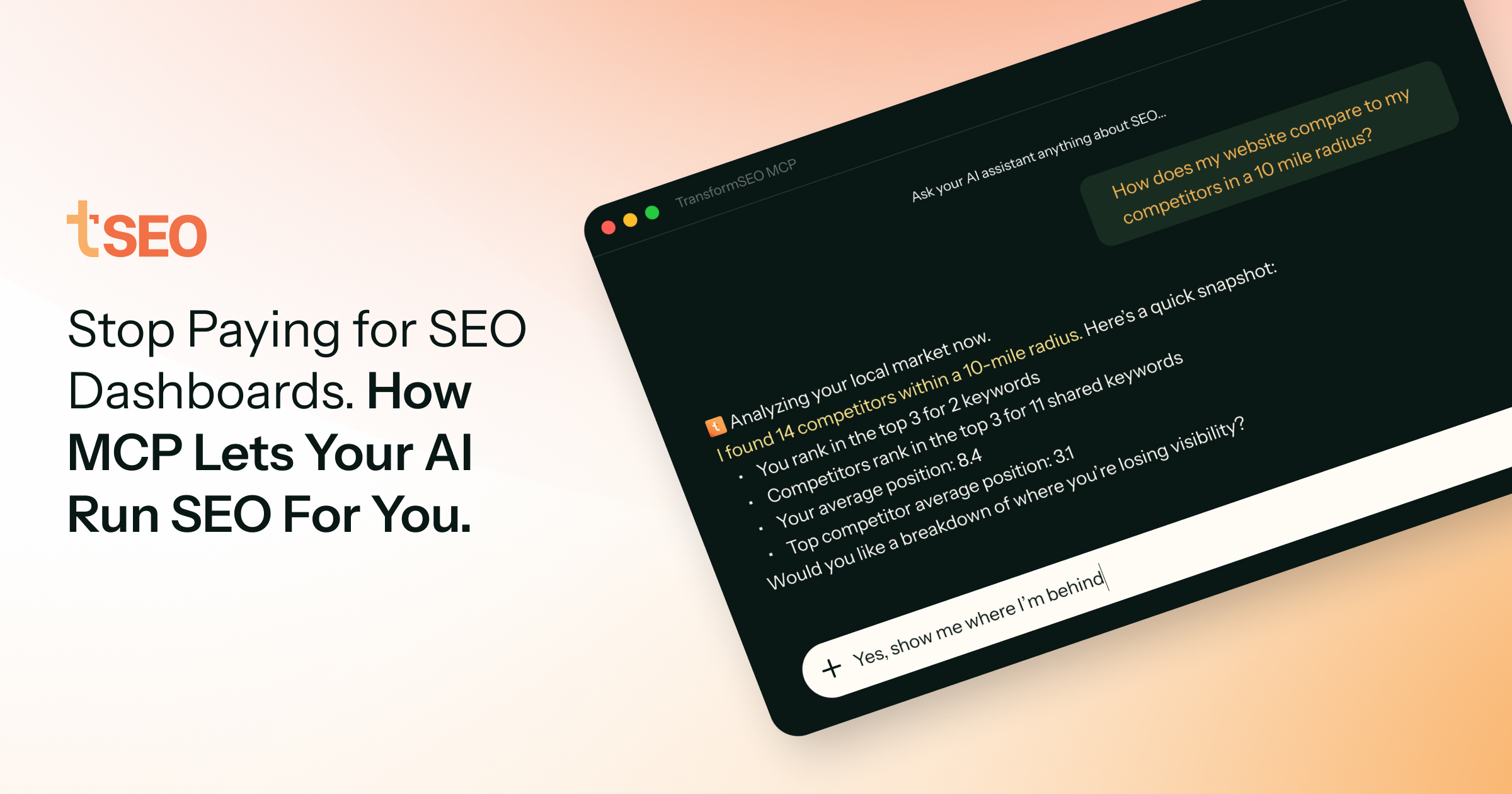
All five are tracked natively in transformSEO. The AI Visibility tools are also exposed via MCP, so you can ask Claude on Monday morning "did anything move in my GEO scores last week?" and get a real answer.
For the why-MCP-matters depth, see Stop Paying for SEO Dashboards. For the AI Visibility deep dive, see AI Visibility: The SEO Metric You're Not Tracking.
Common Mistakes (And the Fix)
I have audited a lot of GEO programs in the last six months. Five mistakes show up over and over.
Mistake 1: Treating GEO as a content-only problem. Half of GEO is technical. Crawlability, page speed, schema, internal linking. If you skip the technical layer, no amount of content tightening will fix your citations.
Mistake 2: Optimizing for one model. ChatGPT is loud. Claude, Gemini, and Perplexity are quietly capturing buyer intent in different niches. A program tuned only for ChatGPT will leak market share to the other three.
Mistake 3: Ignoring brand corpus signals. This is the slowest and most powerful lever. If your brand is not in Wikipedia, Reddit, GitHub, and the mainstream press, you are leaving long-term citations on the table. Start now.
Mistake 4: Counting brand mentions as citations. A mention is "they said our name." A citation is "they linked to our page." Mentions help brand. Citations send traffic. Don't conflate them.
Mistake 5: Running GEO without traditional SEO discipline. GEO is additive, not substitutive. Your Google rank tracking, backlink program, and content audits all still matter. The teams that win run both motions in parallel.
Where GEO Is Heading
Three calls for the next 18 months.
Call 1: AI Overviews become the dominant Google surface. Google is rolling out AI Overviews to more queries every quarter. By late 2026, the majority of commercial queries on Google will return an AI-generated summary above the organic results. Optimizing for that surface (which sits at the intersection of traditional SEO and GEO) becomes table stakes.
Call 2: Agent-driven buying becomes a measurable channel. Right now, AI agents recommend brands. By late 2027, agents will be booking, scheduling, and purchasing on the user's behalf. The brands that show up in the agent's shortlist will eat the brands that don't. We are building the instrumentation for this surface now.
Call 3: GEO splits from SEO at the role level. Right now, the SEO team handles GEO. By 2027, large companies will hire dedicated GEO analysts the way they hired SEO specialists in 2010. The skill overlap stays high (it is the same web). The metrics, tools, and tactics diverge enough to specialize.
How to Get Started Today
Three concrete next moves, in order of effort.
1. Run the free AI Visibility scan. Five minutes. No signup. /tools/ai-visibility. This is your baseline.
2. Run the free SEO audit. Thirty seconds. No signup. /audit. This catches the technical gaps before they kill your citation potential.
3. Sign up for the free transformSEO account. Track 10 keywords on a weekly cadence at no cost. The full GEO toolkit (165 tools across 15 categories) is exposed via MCP if you want to drive it from Claude or Cursor. Free forever.
When you outgrow the free tier, the Pro plan is $79 a month for three sites and 250 keywords. Most GEO programs land there by month two.